
Biography/Gear
EDUCATION
Private study with guitarist Linc Chamberland. After playing with R&B bands in the 1960s and recording an album for Motown in 1972, Linc stopped touring, became a private teacher, and performed locally in Norwalk, CT. Linc recorded two well regarded jazz albums for Muse Records, A Place Within in 1976 and Yet to Come (with bassist David Friesen) in 1983.
Private study with pianist John Mehegan whose four-volume work, ''Jazz Improvisation,'' is one of the most widely used publications for teaching jazz piano. Mehegan wrote the incidental music for A Streetcar Named Desire which he performed on Broadway for two years. Leonard Bernstein dedicated the second movement of his 1948 composition Four Anniversaries "For Johnny Mehegan (June 6, 1920)". On March 23, 1984 when it was known that Mehegan had a terminal illness, a concert in his honor attended by more than 600 people was held at Symphony Space. The performers included Gerry Mulligan, Dave Brubeck, Jill McManus and Larry Willis.
Both men were valuable mentors to John, allowing him to play with them as he progressed in his development, and both were not surprised when John was chosen "talent deserving wider recognition" by Downbeat's international Critic's Poll, 1978 and 1979.
PERFORMING CAREER
In 1983, John joined flutist Paul Horn, bassist David Friesen and Paul's son Robin Horn for a historic tour of the Soviet Union. This was the first time in forty years that an American jazz group had been invited to play public performances in Russia. In 1993, 1995, 1998 and 2012 John returned to Russia, playing in numerous cities. Two sold-out performances in Kursk may have been the first appearances there by an American jazz musician.
With bassist David Friesen, John was featured of the soundtracks of two Academy Award Nominated short films (Will Vinton Studios, Portland, OR, and Bosustow Studios, Los Angeles, CA).
"Through the Listening Glass" with David Friesen was chosen of the "Ten Best Jazz Albums of the Decade" by the Los Angeles Examiner.
John was featured in Japan's "Swing Journal", "The Jazz Guitar" (Ashely Mark Publishing, England), and the Biographical Encyclopedia of Jazz (Leonard Feather and Ira Gitler).
John had several appearances on BET Jazz Discovery and Guitar Series television shows.
Recording/Performance Credits: Milt Jackson, Lionel Hampton, Art Farmer, Conte Condoli, Herb Ellis, Bill Watrous, Mundell Lowe, George Cables, Billy Higgins, Billy Hart, Richie Cole, Paul Horn, Tom Harrell, Don Thompson, Dave Liebman, Golden Delicious (Inner City, 1977), Through the Listening Glass with David Friesen (Inner City, 1978), Other Mansions with David Friesen (Inner City, 1980), Somewhere (Seraphon, 1995), Picture in Black and White with Uwe Kropinski (Acoustic Music, 1997), Elle (Jardis, 2000), Scenes (Origin, 2001), The Banff Sessions (Origin, 2002), Listen to This with Frank Haunschild (Acoustic Music, 2004), Resonance (Origin, 2005), Solitary Tales (Origin, 2009), Shot Through with Beauty with Michael Zilber (Origin, 2011), New York Conversations with Kendra Shank (TCB, 2013), Italian Conversation with Michele Campobasso and Viz Maurogiovanni (Terramiamusic, 2014), Anytime with Tomas Sauter (Catwalk, 2016), Cosmology with Rolf Jardemark (Guitarlandrecords, 2016), Night Visitor with Ulf Bandgren (Origin, 2017), Petite Fleur with Dave Liebman (Origin, 2018), Rain Painting (Origin, 2021).
John maintains a robust live performance schedule touring in the Pacific Northwest, the United States, Europe, and Asia.
TEACHING AND CLINICS
John has numerous online courses and lessons published with Truefire, Modern Guitar Harmony, Guitar Vivo, DC Music School, Mel Bay and Mike’s Masterclasses. He has taught internationally since the late 1970’s, frequently doing short residencies. In addition to being a virtuoso soloist, he has been called an inspiration to students at every level of musical development because of his wonderful ability to translate complicated theory into meaningful insights and creative applications. He is known for his pragmatic, intuitive teaching style that involves his students and helps them find their own voices in the music. John is able to speak with authority about the music business as well as a result of his long tenure as a working and touring player.
“The purpose of my clinics is to provide insights into both the technical and creative processes for both the student musicians and the serious listener. An informal performance by me is followed by an open-ended question and answer session covering topics ranging from the nature of improvisation and harmony to elements of the music business and self-promotion. In a master class setting, specific demonstrations of scales, substitutions, chord construction and embellishment will also be addressed. Students are also encouraged to play with me and in their own ensembles. Constructive evaluations and critiques will follow.”
John has been Artist-In-Residence at schools in Germany, Indonesia, Argentina, and in the United States and Canada. He served as assistant director and performer in Oregon Public Broadcasting's PDX Jazz Summit in 1991, and since 1995 has been a contributing columnist for a number of magazines, including "Downbeat", "Guitar Player", "Canadian Musician", "Soundcheck" (Germany), and "Guitar Club" (Italy).
Clinics have included: International Association of Jazz Educators, Musician's Institute, Dick Grove School, Berklee School of Music, Manhattan School of Music, Lionel Hampton School of Music, University of North Texas, Escuela Para La Formacion Integral (De Musicos, Buenos Aires, Argentina), University of Utah, BMI Arranger's Workshop with Bob Brookmeyer, and Manny Albam, Stanford Jazz Workshop, University of Southern California, National Guitar Summer Workshop, Bud Shank's Pt. Townsend Clinic/Festival, Institut Musik Daya, (Jakarta, Indonesia), and dozens of others in the USA, Canada, Asia and South America.
John has numerous online and DVD lessons presented by Truefire including Modern Jazz Harmony Playbook, Modern Chord Melody, Modern Jazz Progressions, Modern Jazz Improvisation. In addition the DC Music School has streamed video lessons “In the Style of John Stowell” Volumes 1-4 which features lessons where John shares his approach to music and video performances of John improvising on standard changes that are fully transcribed in standard notation and TAB.
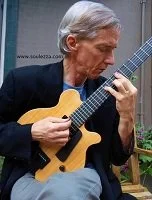
Soulezza Headless Guitar: John Stowell Signature Model
He now plays and endorses a Soulezza headless signature guitar available at :
w w w . S o u l e z z a . c o m
This signature headless semi-acoustic guitar features an all chambered mahogany body, a single neck humbucker, and a custom ebony pickguard.
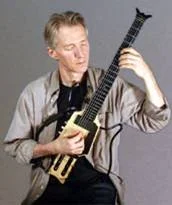
Mike Doolin: John Stowell Model
John Stowell is an electric jazz guitarist, but he has a fondness for acoustic guitars as well. He asked me to build him a nylon-string acoustic-electric guitar with as much acoustic quality as possible, but not as susceptible to feedback as a classical guitar with a pickup would be. John requested an arm bevel for right-arm comfort, and a slender neck profile which is closer to his electric guitars.I based the body shape on my Classical model, but reduced the body depth to 2-1/2" to limit the bass frequencies that feed back most easily.
I placed the output jack for the pickup system off center on the bass side, again accommodating John's unusual playing position. Like all my instruments, it has my Adjustable Neck Angle System so John can keep the action low like his electric guitars.
Woods include a German spruce top, cocobolo back and sides, and bloodwood binding.
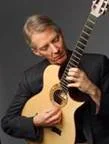
Wright Guitar Soloette: Hybrid Maple
The Hybrid steel string guitar has a slightly narrower neck.
Nut width 1 7/8". Features 22 frets, side dot markers, and strap buttons.
Headphones plug directly into the guitar for stereo sound. (not included) Grado SR60 headphones available on order page.
Guitar plugs directly into a guitar amplifier for use as an electric guitar. Price includes internal amplifier for headphones, soft case, and pickup.
John plays this guitar in YouTube clip: I Wish
For amps and effects, he uses: VSA amps, AER Acousticube 120, Acoustic Image 10/2, Henriksen Jazz Amp. John also uses Tonehunter pedals and Evidence Audio speaker and guitar cables.